Description
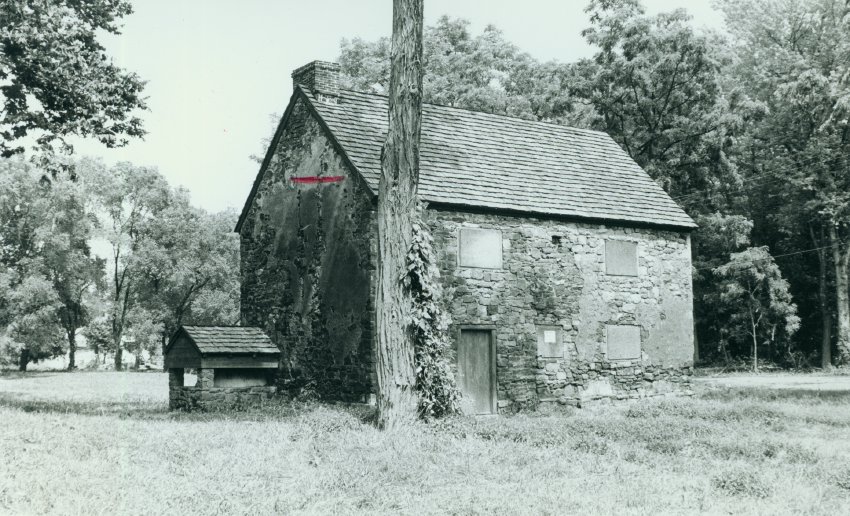
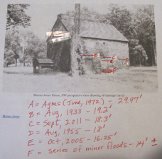
Black and white photographic print showing a northwest perspective view of the partially restored Mouns Jones House. Red mark on photo denotes high water mark (and oil residue) from the June, 1972 flood resultingfrom the week-long rains produced by Hurricane Agnes. The Trust’s Board minutes for November 24, 1972, note that Agnes flood waters reached the "roof ridge" of Mouns Jones House and Bridge Keeper's House and the "second floor" of the White Horse Tavern. According to D.B. Brunner on page 21 of the book cited in footnote {3} below, the September 2, 1850, "freshet"{1} rose a foot above the second story floor of Mouns Jones House. Other major floods occurred in the Schuylkill River channel in 1902 and 1928, as well as the more recent floods in 2006 and 2011, the levels for which are shown in Image
#3.
The replacement door frame in this image aligns with the exterior of the masonry wall. The doorway is unsheathed. Window openings have been adapted{2} for casement windows in a horizontal or roughly square configuration.
Details include: reconstructed bake oven; gable-end chimney (in running-bond brick above the projecting stone flashing ["drip"] course, rubble stone below that level); replaced wooden-shingle roof; datestone niche{3}.
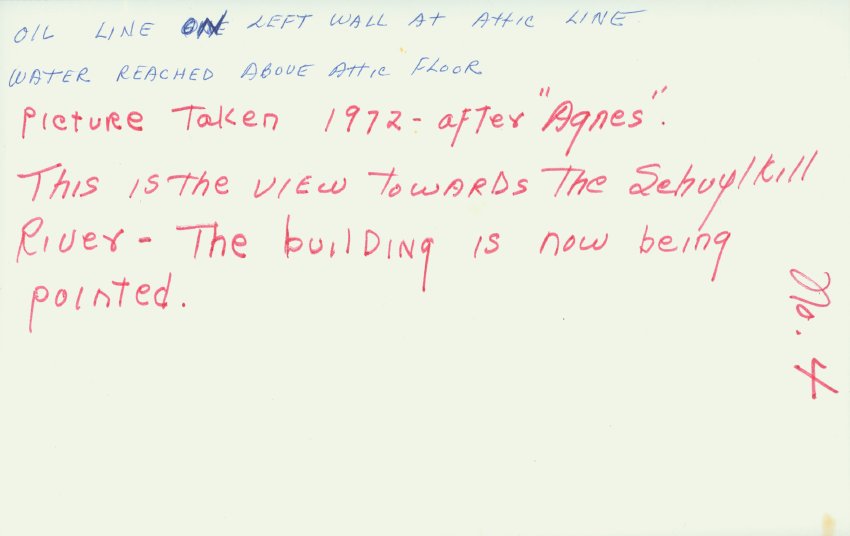
See additional image for notes written on verso, including "the building is now being pointed." A note in the Board minutes for May 24,1973, indicates that the pointing of the house had been completed.
FOOTNOTES
{1} The same 1850 flood which severely damaged the nearby covered bridge. A large section from Reading's Bingaman Street bridge was conveniently transported by the 1850 torrent past Douglassville and came to rest between Douglassville and Pottstown, virtually intact. It was salvaged for use in reconstructing the damaged sections of the Douglassville span.
{2} Except for the window opening in the north bay of the second story, which appears in the same horizontal alignment and approximate size as in an 1886 woodcut drawing [MJHDWG2--1000.01.089]. However, this frame had been temporarily converted to a vertical hung-sash alignment during the restoration campaign, prior to the reversion to the horizontal casement shown here, in the woodcut, and in all photos showing it between c.1902 through c.1964; see record #MJHPH11 in this Archive.
{3} The Trust Board minutes for September 25, 1970, indicate that the date-stone, previously considered lost, destroyed, or stolen, had been recovered, having been preserved by a local resident who respected its significance and became aware that the Trust intended to restore and preserve the 1716 landmark. According to the 1972 date of this photo it is evident that the replacement of the "tablet" [variously
classified as granite or soapstone], identifying the owners Mouns and Ingabo [or "Ingebo"] Jones and dated 1716, was deferred until the appropriate phase of the restoration of the west eaves wall. Page 22 of D.B. Brunner’s classic history "The Indians of Berks County, PA.," Eagle Book Print, Reading, PA (1897), states that the "stone is of a light green color, and does not resemble any mineral in Berks County." Stone similar to this light gray "soapstone" speckled in green is found in Chester County, south of the segment of Union Township across the river from this site.
The datestone was returned to the niche later in 1972: SEE MJHPH46--1000.01.050, a photo also dated 1972, showing the datestone in place in the niche and the replacement casement windows glazed and installed in their new frames and altered openings.
Laurence Ward, November 2018
Catalog details
- Catalog number
- 1000.01.069
- Alternate number
- MJHPH64
- Accession number
- 1000.01
- Date
- 1972
- Creator
- Unknown
- Object name
- Print, Photographic
- Record type
- Standard
- Classification
- Documentary Artifact