Digital collections

Browse the archive

Search published catalog records or narrow the collection by type and collection.

347 records

Clear filters
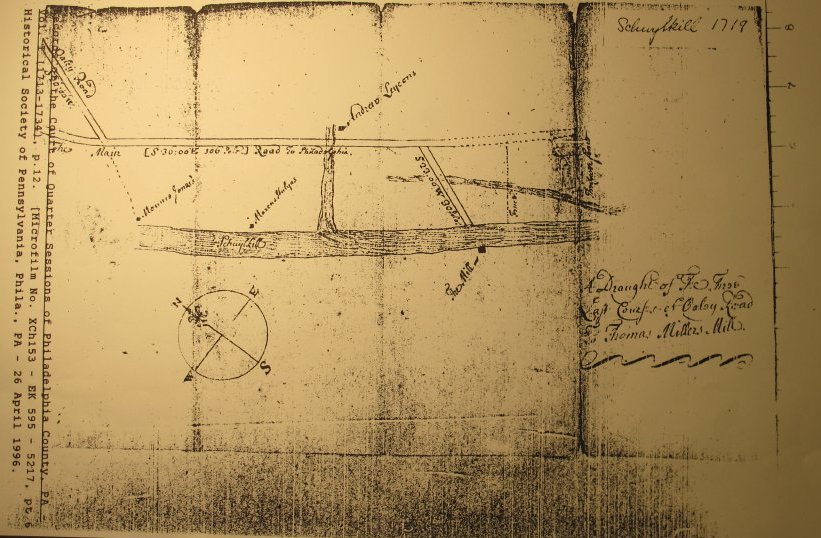
(Copy of Microfilm) "Schuylkill 1719," indicating structure locations
Archives 1003.01.10

“A Draught of The Three Last Courses of Oaley [sic] Road To Thomas Miller’s [Sic, Millard’s] Mill”

Morlatton · 1719

A copy from MICROFILM, by The Historical Society of Pennsylvania: A 1719 map entitled “A Draught of The Three Last Courses of Oaley [sic] Road To Thomas Miller’s [Sic, Millard’s] Mill”, from the public records of the Court of Quarter Sessions of Philadelphia County. This survery “Draught” provides an abundance of historical and topographical details on sites and structures in the Manatawny region [the territory northeast of the Schuylkill River ranging from the French Creek to the site of present-day Reading, later the smaller tract between the Manatawny and Monocacy Creeks on the banks of the Schuylkill] in the first quarter of the 18th century: 1. The approximate and correlative locations of the houses of Mouns Jones, Andrew Lycons, and "Marcus Hulyns" [sometimes called "Huling's" house, which by about 1730 functioned as the first licensed "Publick" House in Manatawny, later the "White Horse Tavern", which in about 1763-5 was relocated slightly northward to the extant stone tavern building on the "Main Road"]. 2. Thomas Millard’s Mill on the opposite river bank about a quarter of a mile down-river from Mouns Jones’s house; 3. The Manatawny segment of the “Main Road to Philadelphia”{a} and its compass readings; {a} This roadway nomenclature indicates that a passable road connected the small Manatawny settlement to Philadelphia, the primary port and commercial center in the mid-Atlantic colonies, by 1719, probably a few years earlier, in response to the 1715 Petition requesting a road to the “Plantations” of Mouns Jones and his neighbors. This “Main Road” land-corridor was critical to the fur trade and general mercantile enterprise conducted by Mouns Jones under an Indian Trader License from William Penn through his agent James Logan. Jones was a holder of a License by 1717 and traded on his own account and in partnership with Anthony Sadowski [Logan Journals, Historical Society of Pennsylvania]. The transactions recorded in the Logan Ledgers in this period between Logan and Mouns Jones and his son Peter, sometimes including the “Manatawny Polander” Sadowski as their partner, indicate that the Manatawny traders were hauling [also “Hawling” or “waggoning”] large quantities of consumer and Indian Trade goods by wagon in exchange for furs acquired from the Native Americans, over the “Main Road” delineated on this Draught. 4. The “Oaley [sic] Road, the main artery for the transport of grain and other crops from the fertile Oley Valley to Millard’s mill and to the road systems through Montgomery and Chester Counties to Philadelphia. 5. The compass Bearing of the last course of the Oaley Road to the ford crossing to Millard’s mill; 6. The approximate compass alignment of the Schuylkill River. Laurence Ward, June 2016

View record
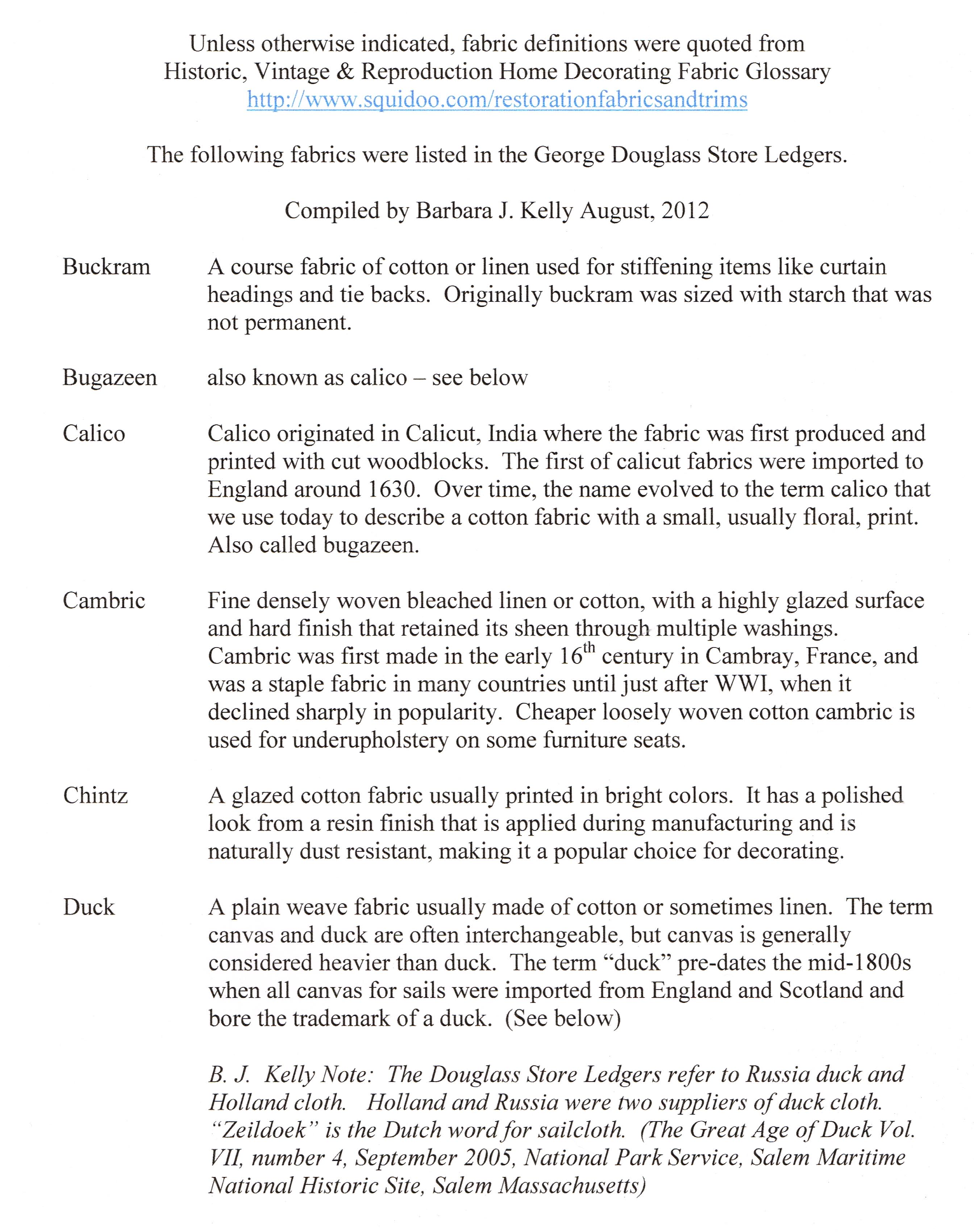
Page 1 of 3 footnotes
Archives 1008.01.041

"foot notes on textiles"

General Information · 2012 August

Compiled by Barbara Kelly 2012 August notes taken from the George Douglass Store Ledger. Notes related to fabrics that were listed in the ledgers.

View record
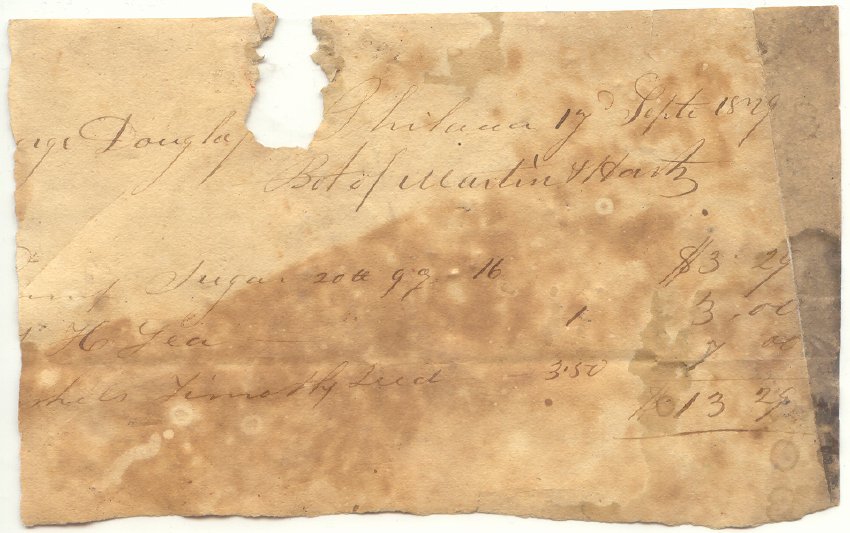
George Doughlass receipt
Archives 1006.01.029

"George Douglass (Jr.) Receipt"

George Douglass · 1829 September

Incomplete receipt on piece of parchment [Geo]rge Douglass (Jr.) Philadelphia 17 Sept[ember] 1829 Bot of Martin and (+) Hartz [?] Sugar 20 u[nits] [at or times] 16 $3.29 1 T Tea 1 3.00 [2 b]ahils (bails) Timothy Seed 3.50 7.00 $ 13.29

View record
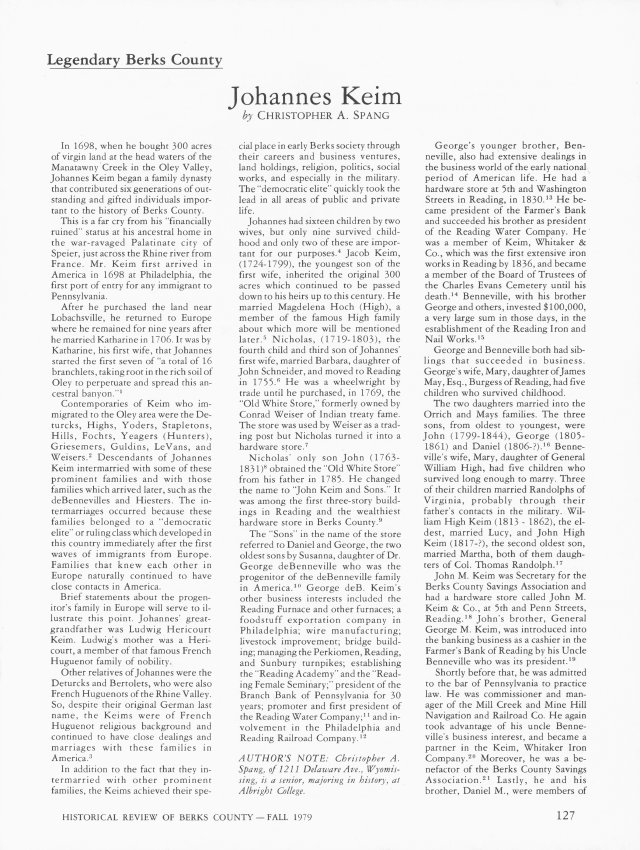
Keim, Family History, Page #1 (1979)
Archives 1002.01.058

"Johannes Keim"--article on Keim history

Keim · Fall 1979

Three-page of article titled "Johannes Keim" by christopher A. Spang appearing in the Fall 1979 (Volume XLIV, No. 4) issue of "Historical Review of Berks County," a quarterly publication of the Historical Society of Berks County. Article gives a brief history of Johannes Keim (starting in 1698) and key descendants ending in the mid 19th century. Topics disccussed include various Keim business dealings, land holdings (including the Keim Farmstead), religious activities, and military service. See additional images or MULTIMEDIA LINKS for complete text.

View record
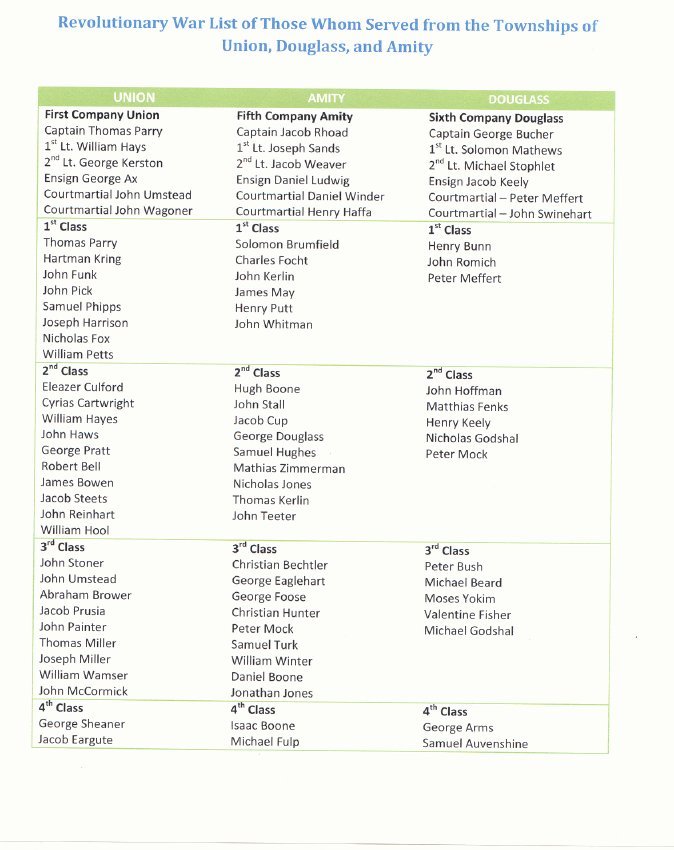
Muster Roll List - Page 1 of 3
Archives 1008.01.039

"Muster Roll"

General Information · 1986

A recreated Revolutionary War (Muster Rolls) List of Those Whom Served from the Townships of Union, Douglass, and Amity. The information was provided by the following citation. Citation (see note): Hollenbach, Raymond. Berks County Soldiers in the American Revolution. Berks County, PA: Berks County Genealogical Society, 1986. LCCN: 86157913 59, [29] p.: ill.; 22 cm. Includes index. Registers of births, etc.--Pennsylvania--Berks County. Soldiers--Pennsylvania--Berks County--Genealogy. Berks County (Pa.)--Genealogy. Pennsylvania--History--Revolution, 1775-1783-- Registers. United States--History--Revolution, 1775-1783--Registers.

View record
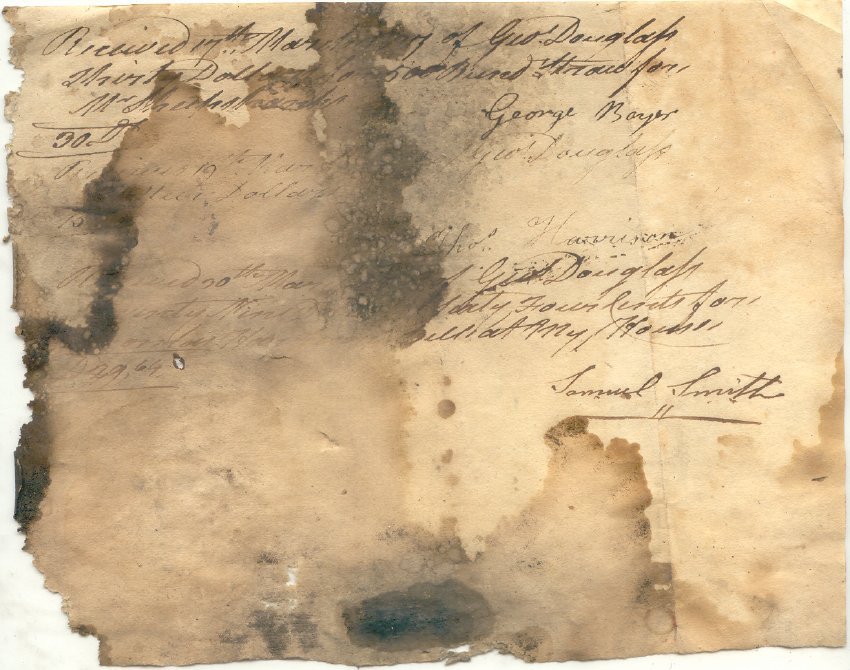
Receipt/Payment Received for George Douglass
Archives 1006.01.031

"Payment Received/Receipt"

George Douglass · 1827 March

Payment Received/Receipt: Three Dates: 17th March 1827, 19th March 1827, 30th March 1827 Signed off by George Boyer, Thomas Harrison, and Samual Smith on payments received by George Douglass for; Mr. Sheepshank and himself. "Received 17th March 1827 of George Douglass Thirty Dollars for 500 Bined Straw for Mr Sheepshank --------- 30 D George Boyer --------- Received 19th March 1827 of George Douglass Fifteen Dollars --------- 15 Tho[mas] Harrison --------- Received 30th March 1827 of George Douglass Twenty nine Dollars and sixty four cents for Thomas Harrison bill at my house ---------- D 29,64 Samual Smith" -----------

View record
No image
Archives 1000.01.122

"Plantations" in Early Pennsylvania

Mouns Jones

Plantations in Early Pennsylvania Within five years after settling on the banks of the Schuylkill River on their tracts north of the Manatawny Creek, Mouns Jones and his neighbors petitioned the Royal Governor in 1709 for a road for the convenient passage to and from their “plantations”, describing both their individually surveyed and “patented” farmlands and the agrarian settlement community they had “planted” there. The term was used in both senses in various contexts in early documents. In his 1681 “Account of the Province Of Pennsylvania In America”, William Penn explicitly and repeatedly used “plantations” [the “seeds of nations”] as a synonym for “Colonies” [e.g., the “Greeks planted many parts of Asia…” according to Penn]. Regarding his vast wooded Province, Penn was unequivocally describing the settled and occupied areas of the colony to which the First Purchasers had “transplanted” themselves, their families, and their cultural traditions. Penn’s First Purchasers were figuratively “taking root” in the lands and emerging communities they occupied. According to the journals of Evans, Bartram, and Weiser describing their 1743 journey from Bartram’s homestead SW of Philadelphia [formerly the site of Mouns Jones’ first “plantation”] through Tulpehocken to Onondaga, NY, the three journalists perceived a lack of development of “arts and sciences” by Natives in America before its “plantation by the whites...”, an unequivocal reference to the settlement and development of Penn’s expansive “Sylvania” by European immigrants. However, in the same set of narratives, Lewis Evans used “plantation” to designate agricultural land holdings, observing that “Tulpohoocking [sic] is settled by High Dutchers, who have fine plantations, raise great quantities of wheat”, milled to “very fine flour, which they bring in the spring and fall seventy or eighty miles to Philadelphia.” The 18th century wagon road from Tulpehocken to Philadelphia traversed north-central Berks County, joined the “Oaley” road near the Boone family’s land holdings and mill, passed the Black Horse and White Horse Taverns in Morlatton, then turned to the southeast through Perkiomen and Germantown to the bustling market hub of Philadelphia. The British noblemen appointed to supervise trade between England and the colonies, unofficially known as the “Lords of Trade”, were officially designated the “Committee of Trades and Plantations.” Although semantically ambiguous, the Lords’ jurisdiction related to commerce with all communities in Penn’s colony, not merely to the farmers living on and working their cleared and “planted” fields. The term “plantation” soon expressed a related but different meaning: a tract of land with a significant portion of its acreage seasonally “planted” with subsistence produce, barter goods, and cash crops. Amos Long has observed that “Large farmsteads were frequently referred to as a plantation on early legal descriptions and deeds.” The Annals of Swedes on the Delaware described the “manner in which a colony from Sweden was first planted here…”, a clear use of the term as denoting a communal immigrant settlement. The use of “Plantation” persisted in the riverside settlement, described as “Manatawny” in early documents, later becaming known as “Molatton”, then “Morlatton”, through the middle of the 18th century. A 1751 advertisement for the sale of the White Horse Tavern, then located in the riverfront house formerly occupied by Marcus Huling a short distance down-river from Mouns Jones house, included the Tavern-owner’s entire “plantation, which lies on the road by the Swedes”. It is apparent from contemporary sources that “plantation” conveyed two distinct meanings during the first century of settlement in Pennsylvania. Penn wrote that the first “planters” in these parts were the Dutch and soon after the Swedes and Finns”, both skilled and productive in “husbandry.” The term concurrently designated both the populated communities developing within Penn’s Province and the substantial family farmsteads spreading across the cleared tillable ranges of Penn’s vast rolling piedmont. L. Ward, 9/19/15

View record
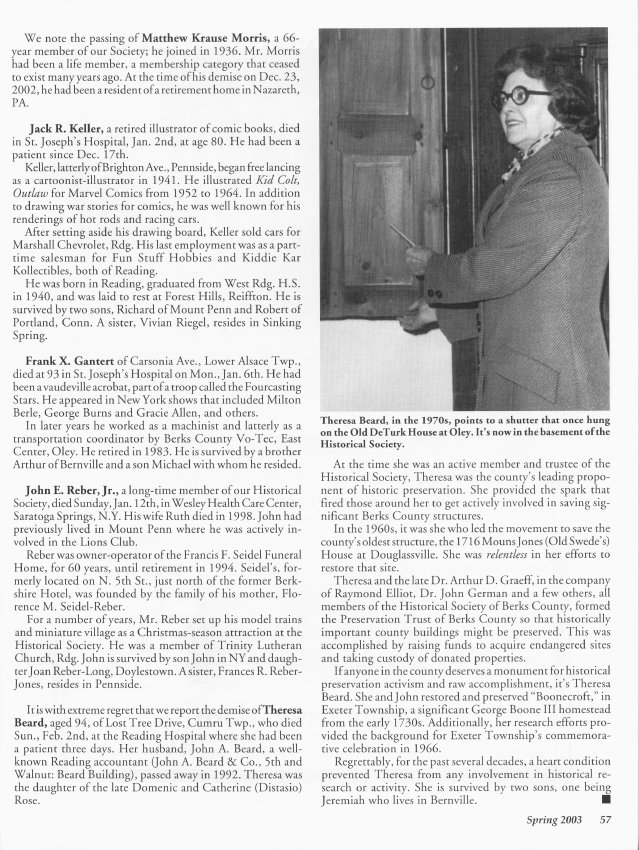
General Info, Theresa Beard's obituary (2003)
Archives 1008.01.002

"Random

General Information · Spring 2003

Six paragraphs of text appearing at the end of a column titled "Random Thoughts" written by George M. Meiser, IX and appearing on page 57 in the Spring 2003 (volume 68, number 2) issue of "Historical Review of Berks County," quarterly journal of the Historical Society of Berks County. Paragraphs document Theresa's involvement with historic preservation and serve as an obituary.

View record
Receipt / Payment received George Douglass (Jr) from M Denekla
Archives 1006.01.032

"Receipt / Payment recevied'

George Douglass · 1807 June

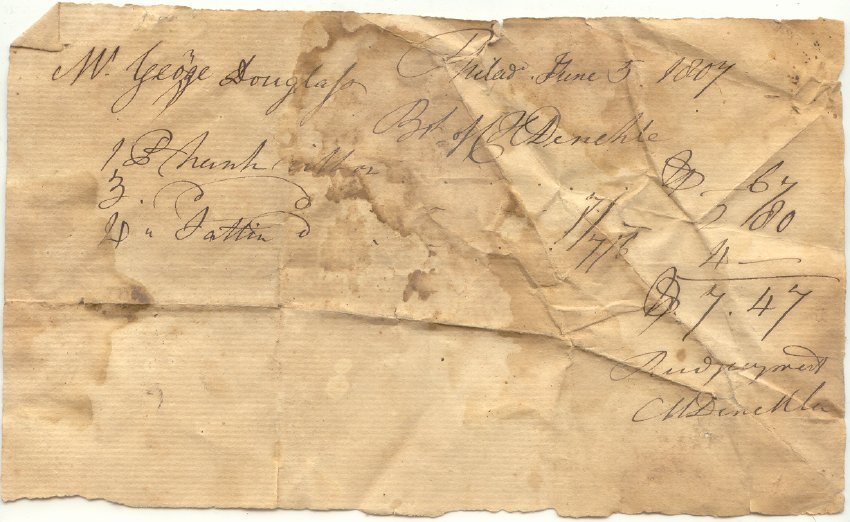
Receipt / Payment received Mr. George Douglass bot of Mr M Denekle Location: Phildelphia Date: 3 June 1807 Philad[elphia] June 5 1807 Mr. George Douglass Bot (bought) of Mr. M Denekle 1 (symbol means "paid"?) trunk? mirror (paid symbol) ___67 3. ( paid symbol?) 7/7/6 2 80 4. sattin (satin?) (paid symbol) 4___ (paid symbol) 7.47 Received payment M Denekle

View record
1814 General election returns for Amity Township from White Horse Tavern
Archives 1007.01.002

1814 general election returns for Amity Township

White Horse Tavern · October 11, 1814

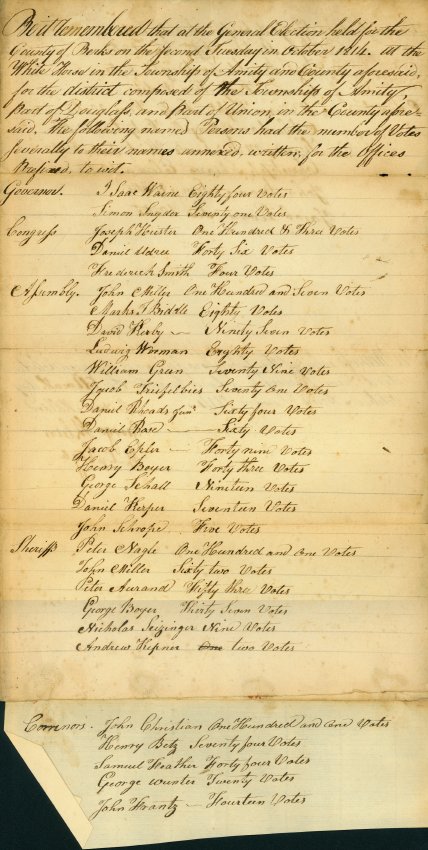
1814 Handwritten report of general election returns for the County of Berks voting district composed of Amity Township and parts of Douglass and Union Townships. Polling was conducted at the White Horse Tavern. Offices open for election were Governor, Congress, Assembly, Sheriffs, Coroners, Commissioners & Auditors. Each candidate is listed along with the number of votes he received. Document signed by witnessing judges. In 1789 Berks County had been divided into 5 Election Districts; electors in the 5th District [Amity, Colebrookdale, Douglass, Earl, and Union] were directed to vote “at the public house of William Witman-called the White Horse” [Montgomery, "History of Berks County" (1886), page 475]. By 1814, undoubtedly because of population growth and long travel times from the perimeter of the vast 1789 District, its area had been reduced considerably to the Amity and the adjacent portions of Union and Douglass Townships. See additional image or MULTIMEDIA LINKS for view of reverse side.

View record
41: Drawing by Barry Stover
Archives 1000.01.135

1957 HABS drawing of Mouns Jones “Ruins”

Mouns Jones

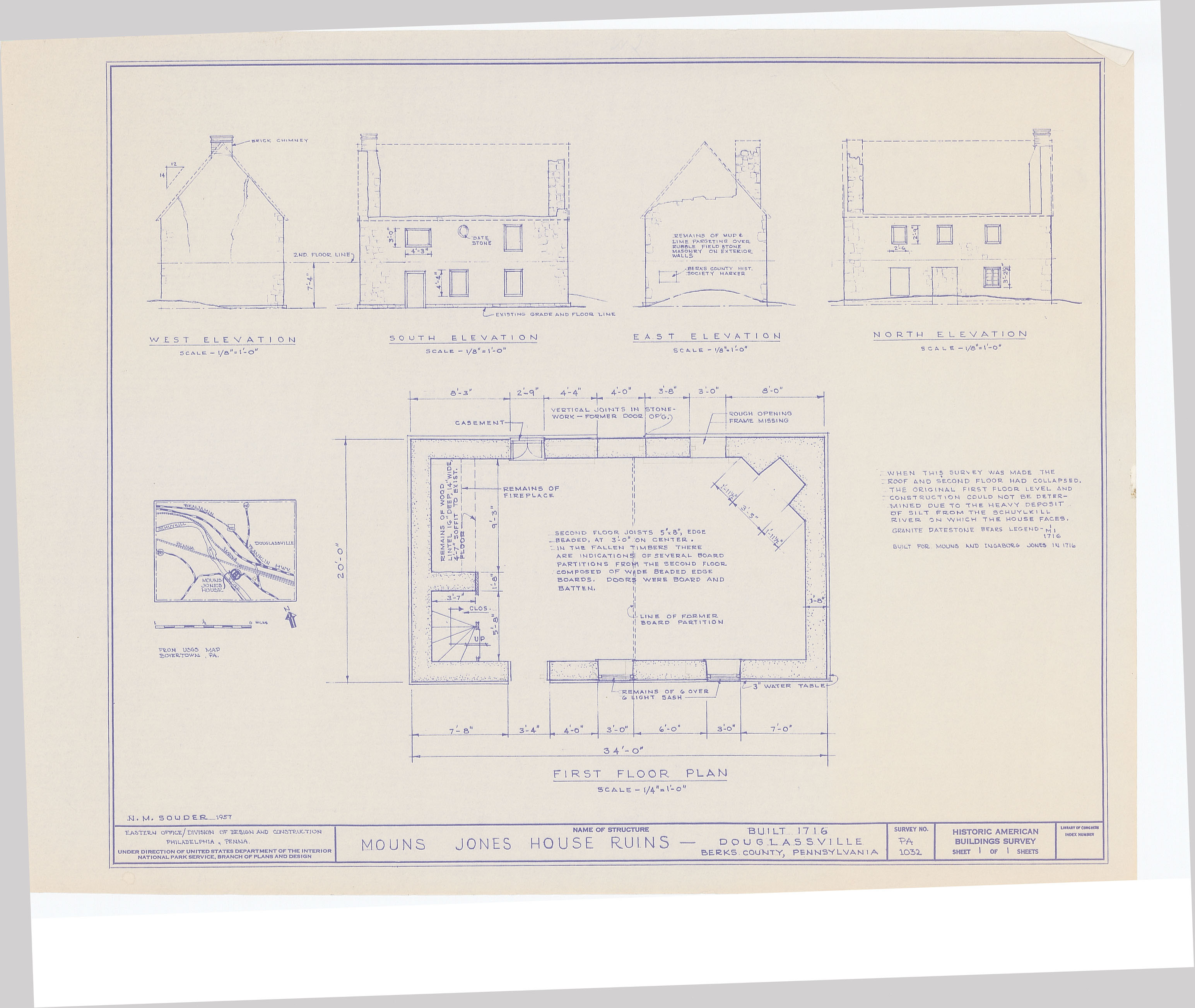
Plans and elevations on this sheet show the c. 1956-57 loss of the roof and some stonework. The plan also indicates the original locations of the approximately central river-side doorway and the board partition separating the hall/kitchen from the parlor with the corner fireplace. Drawings by Barry Stover.

View record
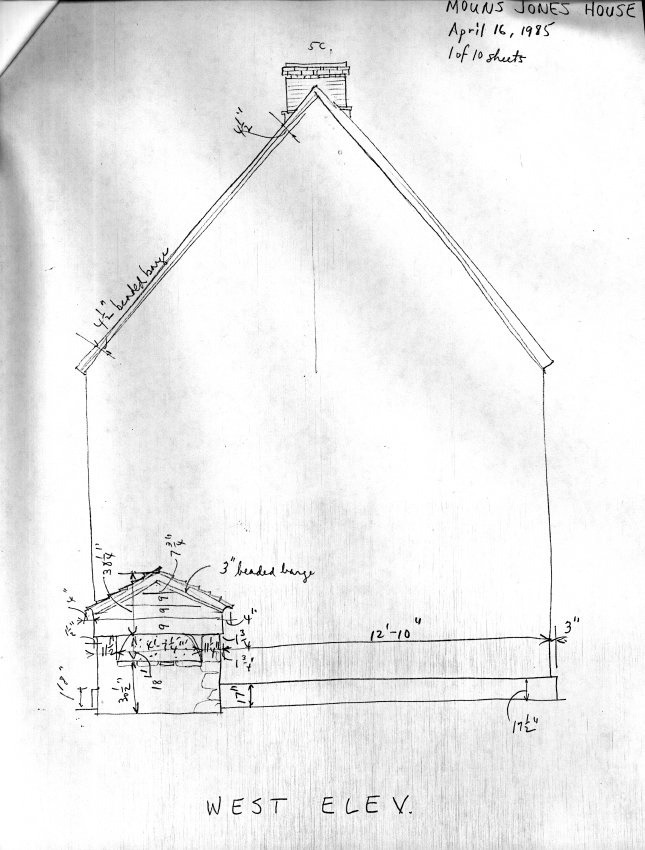
Mouns Jones House, unfiled HABS drawings 1 of 10 (1985)
Archives 1000.01.097

8 pencil field notes drawings with additional data

Mouns Jones · April 16-22, 1985

Elevation drawings based on Field Notes drawings, accompanying notes of surveyor-draftsman, scaled drawing from field notes drawings Description: Series of 8 sheets of dimensioned and annotated pencil drawings accompanied by an unfiled Architectural Data Form, and one sheet of scaled drawings based on the Field Notes drawings, all prepared by Barry K. Stover in the Historic American Buildings Survey (HABS) format. Form and drawings were prepared in order to record the survey and measurement of the building and its components and to update existing HABS information already on file at the Library of Congress in Washington, D.C. These drawings and the accompanying dimensions and other data and notes record the conditions existing on the dates of the sheets. Potentially important information for restoration programs and specifications includes window framing detail{1}. Sheet 9 contains measurements only for the attic window, roof, distance between first and second floor as well as between second floor and attic. Sheet 10 contains information about the house's restoration history gathered by Stover during an interview with Theresa Beard, one of the founders of the Trust, former Trust President and long-time Board member. Please note that sheets 1, 3, 4, and the sheet of dimensioned elevation drawings were included in the "Atlas of Architectural Drawings" published in Morlatton by the Historic Preservation Trust of Berks County in 2008. See MJHTX7---1000.01.096 for the data sheet created by Barry Stover to accompany these drawings. See MJHTX7---1000.01.096 for the data sheet created by Barry Stover to accompany these drawings. FOOTNOTE {1} For example, sheet 7 contains the note "replaced or pieced sill" relative to the "center window north [sic, east] side," possibly suggesting that the "head" [lintel] and two timber jambs of the frame are original or quite early. The sawn rabbets [in these Field Notes called "rebates" as in English nomenclature, which sometimes appeared in the southern tier of mid-Atlantic colonies as "rabit"] which receive the sash and shutter [or leaded casements if rabbet detail interpreted as compatible only for leaded casements is corroborated by additional evidence]. Sheet 8 bears a note in the lower left corner "Old frame, new sill, No rebate inside…" These notes will be carefully compared with the photographic history(a) regarding the forms, alignment, and details of the windows and their frames. (a) For example, see photo MJHPH60--1000.01.065, Image #3, which seems to show that the three second story window frames on this east elevation were in vertical alignment for hung-sash windows, not horizontal casement frames as existed in the east eaves wall when Barry Stover surveyed the house and rendered his field notes pencil drawings in the mid-1980s. Laurence Ward, March, 2016

View record
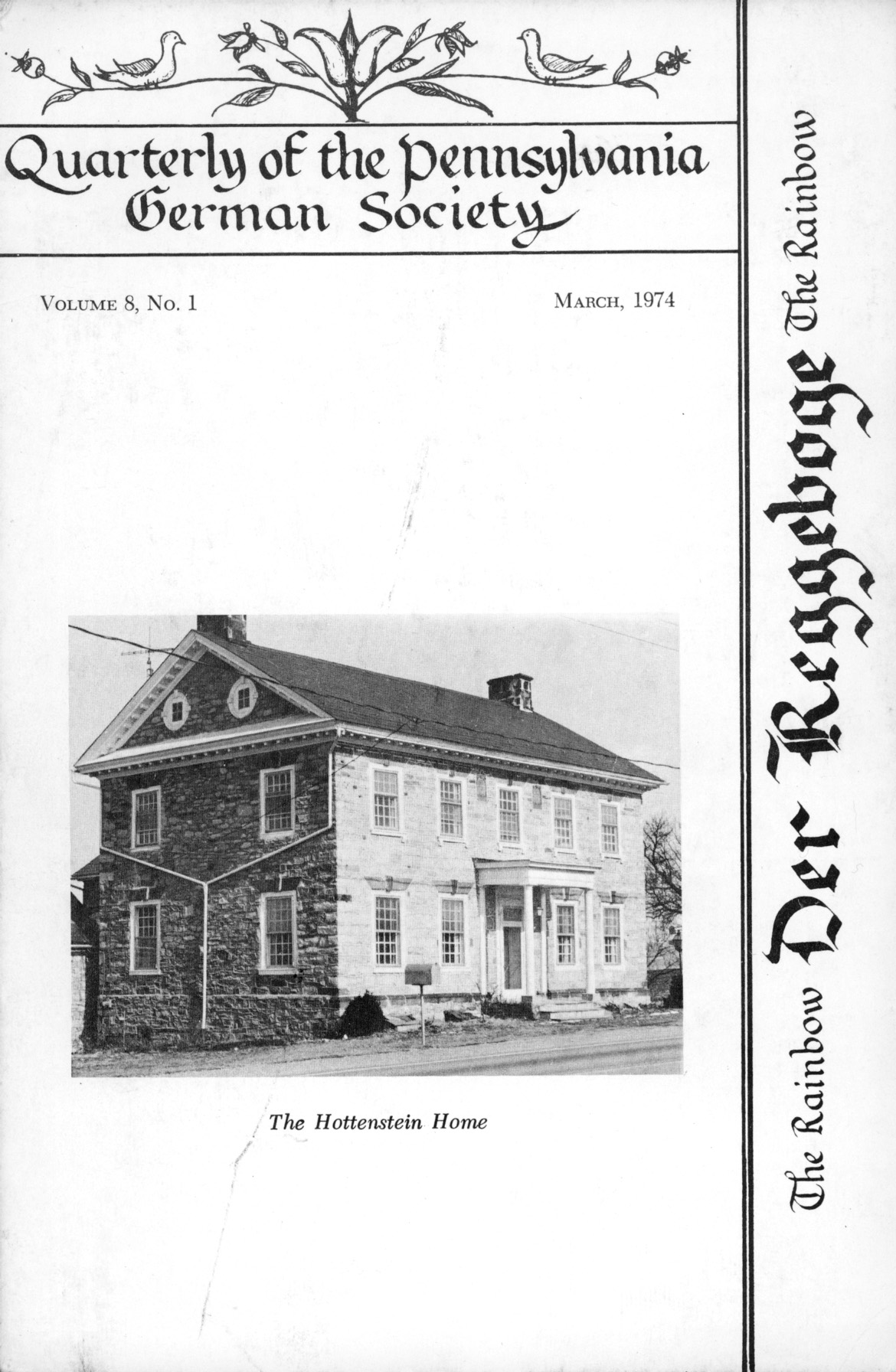
Hottenstein periodical article with photos, cover
Archives 1004.01.001

A VISIT AT THE HOTTENSTEINS -Magazine Article

Hottenstein · 1974 March

A Visit at the Hottensteins, Cover photo and pages 1-3 article in "Der Reggeboge" (The Rainbow), Quarterly of the Pennsylvania German Society, Vol. 8, No. 1, March 1974. Contains 10 Halftone images, interior and exterior, with details, from photographs, with captions. Cover photo shows Victorian porch before 1980s restoration. View additional images or Multimedia Links for the full article.

View record
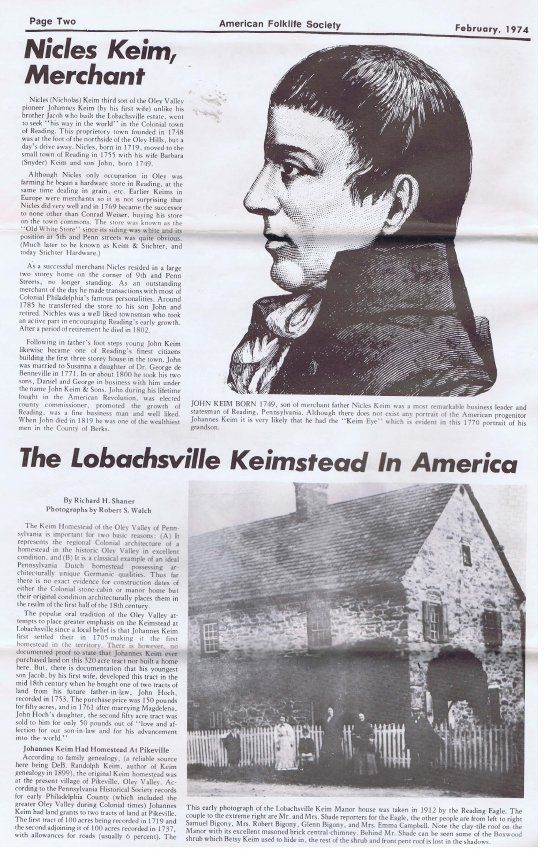
Keim articles, American Folklife, Page 2 (1974)
Archives 1002.01.043

American Folklife, Keim articles

Keim · February 1974

Three-pages of short articles from Volume II, No. 5 (February , 1974) issue of "American Folklife," a monthly newspaper devoted to the American culture published by the American Folklife Society. First article, appearing entirely on page 2 and titled "Nicles Keim, Merchant," gives a brief history of Nicles Keim, third son of John Keim by his first wife and older brother to Jacob Keim who established the Keim Farmstead in Lobachsville. Second article, beginning on page two & ending on page three is entitled "The Lobachsville Keimstead in America" was written by Richard Shaner with photos by Robert Walch. This article presents a brief history of the Keim family as well as evidence supporting the fact that Jacob Keim (NOT John) established the farmstead at Lobachsville. Also presents evidence that John settled near Pikeville. Third article (with photos), appearing entirely on page four and titled "Folklife Plans," features information about the American folklife Society's restoration of the Keim Farmstead buildings, mainly the house and the cabin. Subjects briefly discussed include returing a later modified doorway into a window opening as well as the discovery of colonial brick flooring. See additional images or MULTIMEDIA LINKS for complete images of pages two, three, and four.

View record
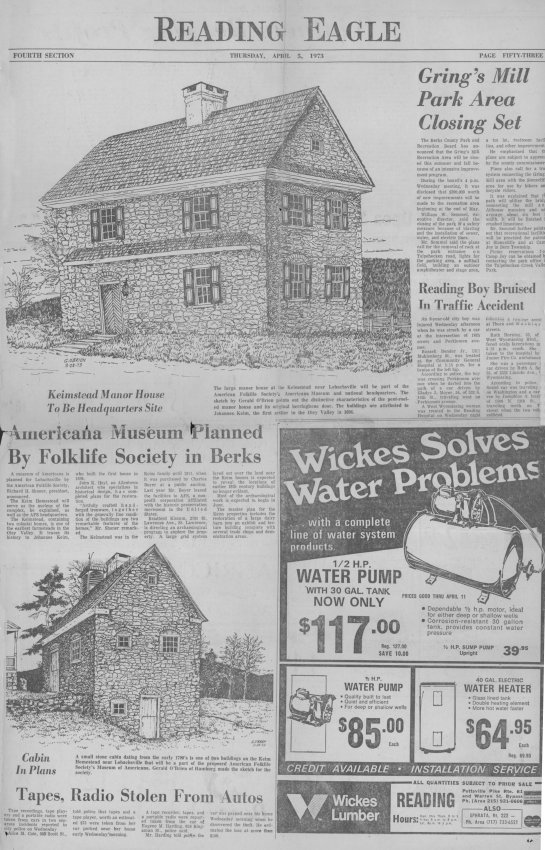
Keim, article & drawings re: Americana Museum (1973)
Archives 1002.01.051

Americana Museum Planned by Folklife Society in Berks

Keim · 04/05/1973

Half-page article with drawings (by Gerald O'Brien) from the Thursday April 5, 1973 edition of the "Reading Eagle." Article appears on page 53, Fourth Section. Article briefly discusses American Folklife Society's (owner of Keim farmstead in 1973) plans for converting the Keim farmstead into a history museum & national headquarters site.

View record
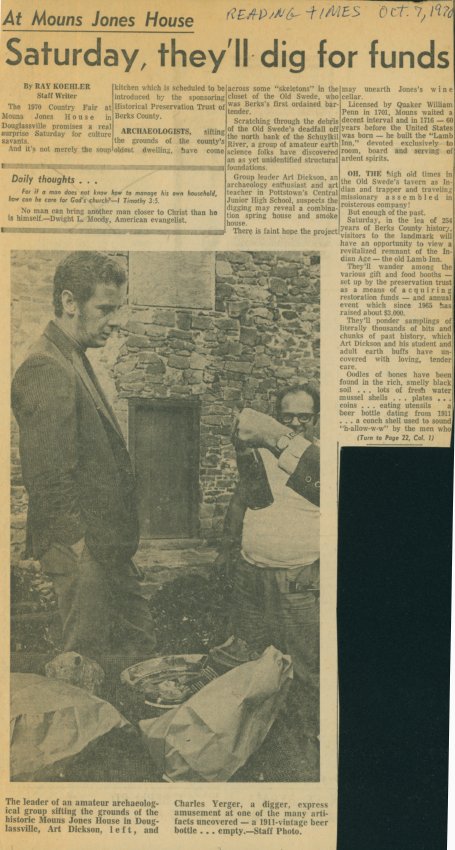
Mouns Jones House, article about arachaeological dig, image #1 (1970)
Archives 1000.01.106

Archaeological dig article from "Reading Times"

Mouns Jones · 10/07/1970

Article titled "Saturday, they'll dig for funds" appearing in the October 7, 1970 edition of the "Reading Times." The piece describes amateur archaeological work being conducting near the Mouns Jones House by Arthur Dickson. Article also briefly mentions the Mouns Jones Country Fair, Mouns Jones History, and HPTBC. See additional image for full text (see note below). Note: page number where beginning of article appears is unknown. However, second portion of article appears on Page 22. Also, article seems to be incomplete. List of HPTBC accomplishments (which ends the article) is missing.

View record
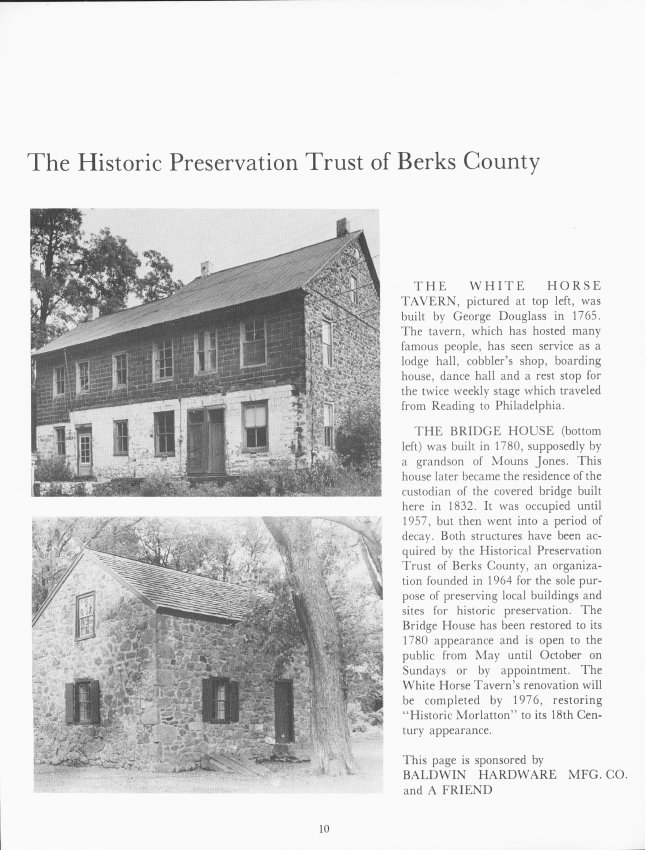
Article about Morlatton Village w/ photo of Theresa Beard, page 10 (1974)
Archives 1003.01.007

Article about Historic Preservation Trust of Berks County

Morlatton · 1974

Two page article (pages 10 & 11) with photos describing the White Horse Tavern, Bridge Keeper's House, and Mouns Jones House and the historical heritage these buildings represent. Second page also features a photograph of Theresa Beard (Mrs. John A. Beard), then president of HPTBC, in front of the Mouns Jones House. Article appears in a softcover book titled "Berks Countians," published in 1974 by the Junior League of Reading, PA, Inc. Book was published in celebration of the league's 50th anniversary. It is located in within the section titled "Historic." See additional image or MULTIMEDIA LINKS for complete text.

View record
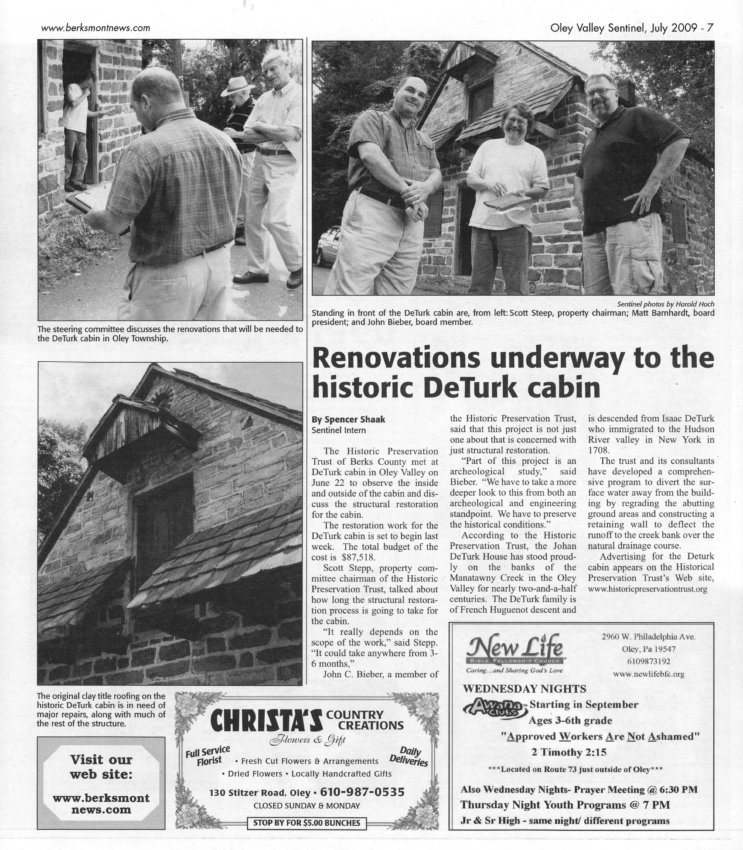
DeTurk, newspaper article on restoration (2009)
Archives 1001.01.178

Article on restoration of DeTurk site-- "Renovations underway to the historic DeTurk cabin"

DeTurk · July 2009

Article on DeTurk House on the front page of "Oley Valley Sentinel: A quarterly publication serving the entire Oley Valley School District," Volume 7, Issue 4, July 2009. Article appearing on page 7 was writeen by Spencer Shaak, Sentinel Intern and contains three photographs. Piece briefly discusses resoration project, its budget, archaeological study, and DeTurk family history. Trust Board members Scott Stepp, Property Committee Chair, and John Bieber are quoted. See DTHPH51--1001.01.177 for front page photograph of DeTurk house referring to this article. Front page image also appears in MULTIMEDIA LINKS and additional images.

View record
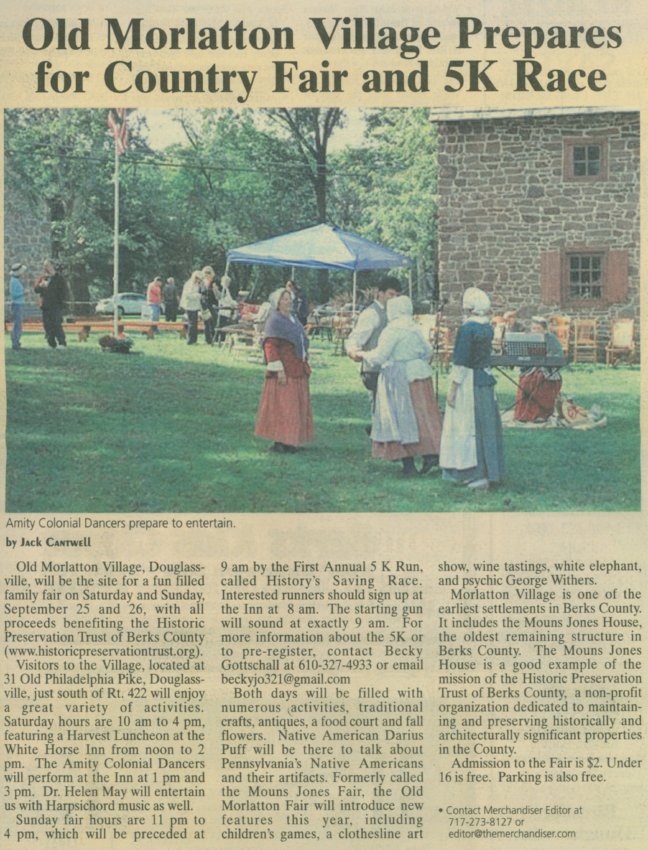
General, article re: Mouns Jones Country Fair 2010
Archives 1008.01.020

Article re: 2010 Country Fair

General Information · 09/08/2010

Front-page article (with photo) published in the September 8, 2010 edition (Volume XLI, No. 41) of the 'Greater Reading Area [eastern edition] Merchandiser." Article discusses dates and activities for the 2010 version of the Country Fair. Note: this article notes a name change for the fair, formerly called the Mouns Jones Country Fair--now named the Old Morlatton Fair. Also, it marks the inception of the Fair as a two-day event ans well as the inclsuion of the (first) Annual 5k Run, called History's Saving Race.

View record
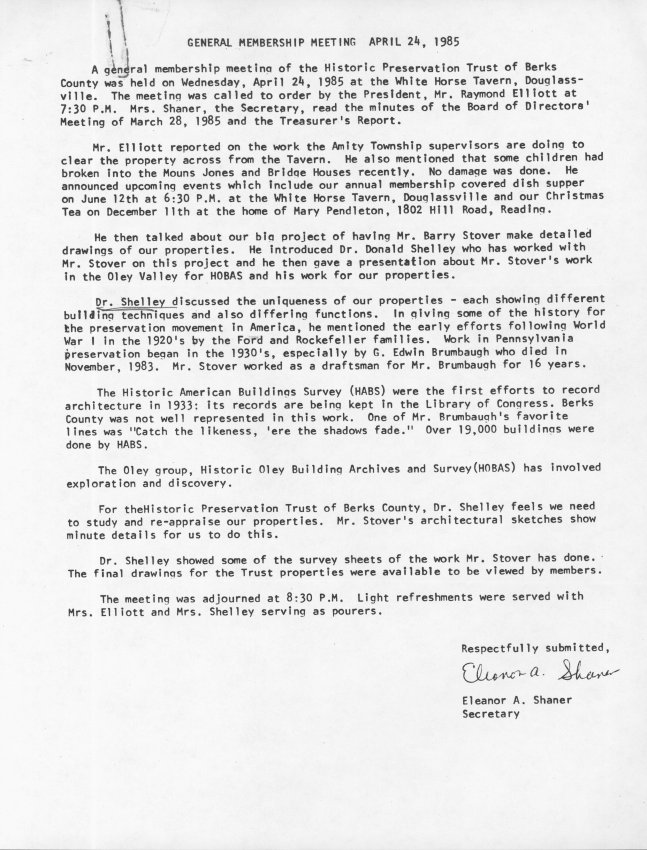
General, board meeting minutes (1985)
Archives 1008.01.008

Board meeting minutes, Apr. 24, 1985

General Information · 1985

One page report outlining the minutes of a board meeting held on April 24, 1985 by the Historic Preservation Trust of Berks County. topics discussed at this meeting include, clearing of property across the street from the White Horse Tavern, break-ins at Mouns Jones and Bridge Keeper's Houses, Barry Stover and his drawings associated with the Historic Oley Building Archives and Survey, and the Historic American Buildings Survey.

View record
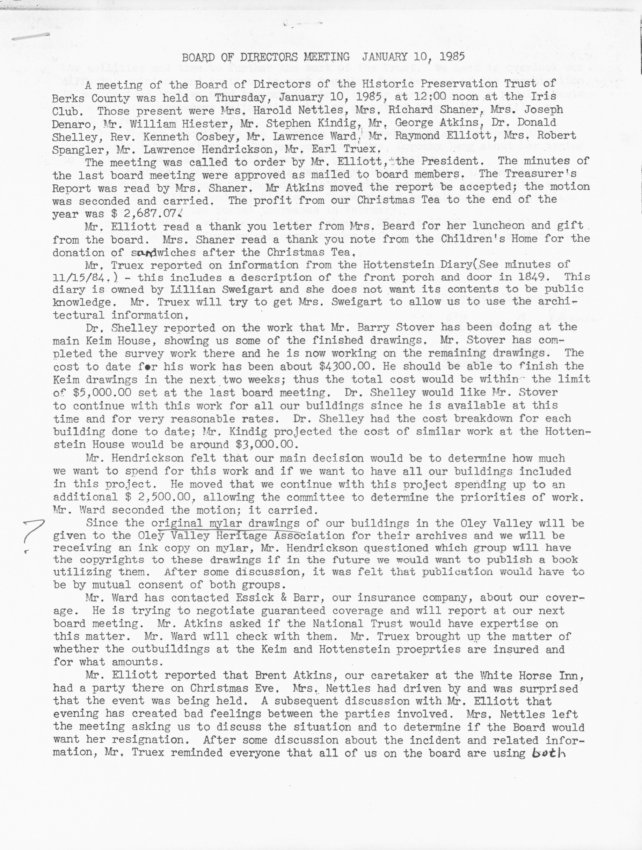
General, board meeting mintues, page 1 (1985)
Archives 1008.01.012

Board meeting minutes, Jan. 10, 1985

General Information · 1985

Two page report outlining the minutes of a board meeting held on April 24, 1985 by the Historic Preservation Trust of Berks County. Topics discussed at this meeting include: treasurer's report, Hottenstein diary, Barry Stover drawings, redware plate project, etc. See additional image for full text.

View record