Description
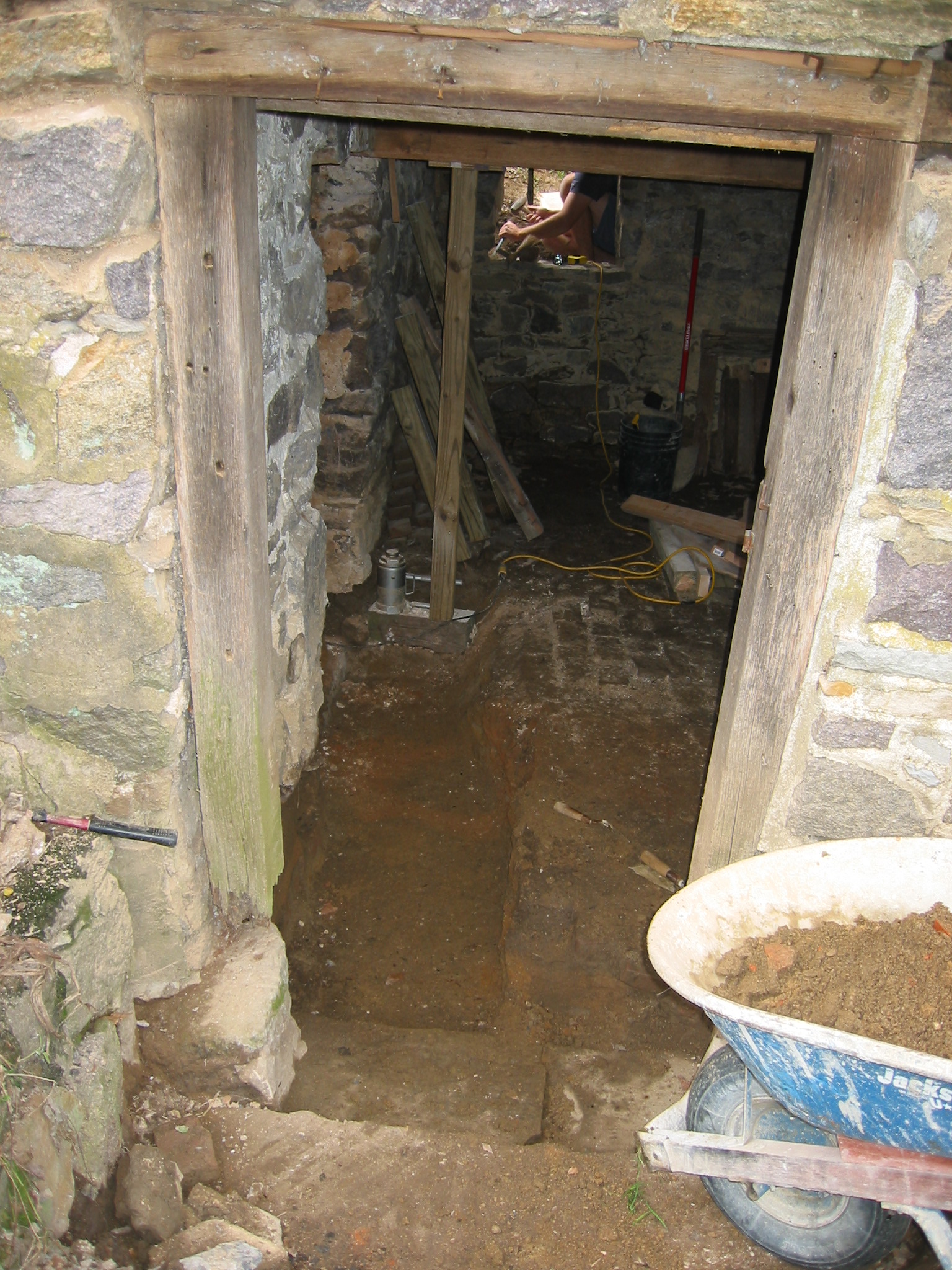
East kitchen cellar entry after excavation to the original stone door sill.
The half-millstone stoop [location detail in photo DTR09PH44--1001.01.128 and see note {1} to DTR09PH41--1001.01.125] along the lower edge of the photo [left of the barrow's wheel] is at an intermediate elevation between the original door-sill [with dark transverse split] and the modern grade approximately 18-20 inches higher.
The 20th-century brick flooring dimly visible in the center of the photo is approximately 18-20 inches above the original floor elevation [see discussion to DTR09PH82--1001.01.171] as determined from original entry and passage stone sill elevations [found], and original brick flooring [found] laid in running bond flush to the earliest [of 3] hearthstones (SEE Field Notes structural plan DTR09FN3--1001.01.176). The later plinth-block ["pedestal stone"] is seen at its raised elevation under the rotted south jamb [lower left]. The mortise ["pin-hole"] chiseled into the plinth below the rotted jamb-foot is the same anchoring detail as found in the original door sill {1}.
The door frame is not original and not at the original elevation [see DTR09PH41--1001.01.125 & DTR09PH42--1001.01.126 and field notes drawing DTR09FN3--1001.01.176 showing door frame lintel tenon {2} several inches above its original pocket in abutting masonry ].
The restored clear-span width of this frame is 36.5 inches, closely based on the dimensions of the south entry doorway to the first floor at the upper ground level. They both provide 76 inches vertical clearance.
FOOTNOTES:
{1} The original mortises at each end of the sill were not usable for the iron pins securing the replacement jambs, since alterations (probably 19th-century restructuring) in the masonry piers required a relocation of the south jamb 2-3 inches to the north of its early location, leaving the original mortises misaligned with the anchor pins lodged in each jamb-foot.
{2} vernacular: "ear"; "tenon" was also spelled "tenent" in a 1797 Chester County, PA carpenter's pricing directory, and sometimes "tenant" in the early period in the southern tier of the mid-Atlantic colonies.
Laurence Ward, 2009
Catalog details
- Catalog number
- 1001.01.127
- Alternate number
- DTR09PH43
- Accession number
- 1001.01
- Date
- 07/21/2009
- Creator
- Larry Ward
- Object name
- Print, Photographic
- Record type
- Standard
- Classification
- Documentary Artifact