Description
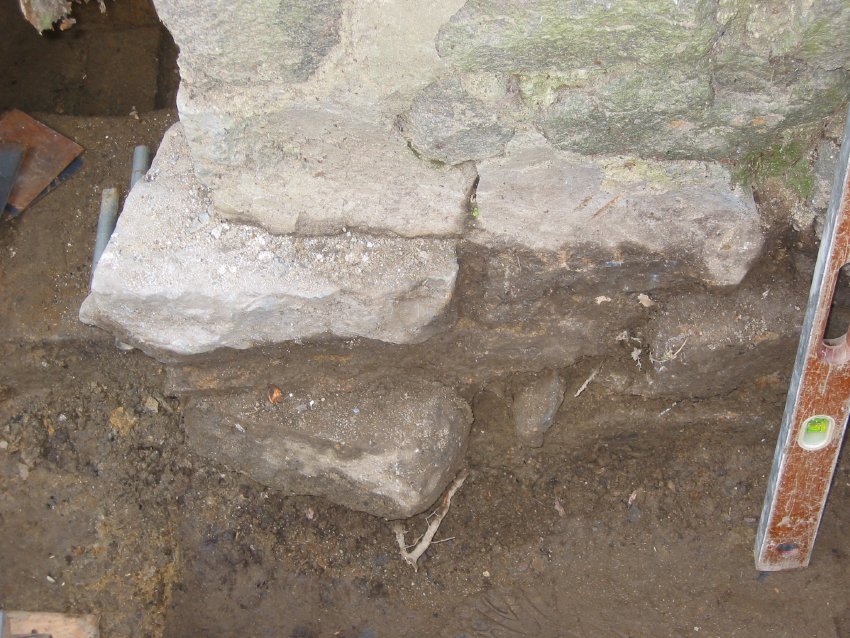
Foundation of pier north of east cellar doorway after partial excavation prior to restoration.
The displaced stones above and below modern grade [stones darkened by wet soil were below modern grade prior to excavation] are shown after removal of rotted later-period jambs. The early setting and pointing mortar, a typical lime-sand mix, applied between the soiled [darker] stones has substantially degraded to sandy mud from saturation caused by the high water table [see discussion in DTR09PH74--1001.01.163] and runoff incursion. The standing water and saturated soil soak the foundation and door jambs for days after moderate-to-heavy rainfall, as shown in numerous photos taken during the months of July-December, 2009. This persistent saturation of the mortar joints requires the application of "hydraulic" mortar designed to inhibit dissolution of the lime or other binding-agent by the addition of a relatively insoluble hardening agent, in these circumstances a higher proportion {1} of "Portland" cement in the traditional mix with sand, water, and mason's lime {2}.
Additional protection of walls in wet areas will include: "parging" {3}; sub-grade membrane flashing; conduction of runoff and flood water away from walls and entries by sloped grading and swales; and retention of the banked terrace along the creek as a "barrier" against periodic flooding.
FOOTNOTES
{1} nearly doubling the modern standard.
{2} The early Egyptians discovered the benefits of burnt limestone ["lime"] as a hardening agent in mortar used in masonry construction. In ancient Rome and territories under its influence, terra cotta granules ["pozzolan," also "pozzolana," or "pozzuolana"], which were compounded from granular volcanic residue combined with other natural compounds and then hydrated, were added to ancient mortar formulations to produce a setting material with low solubility. "Portland" cement is a modern equivalent of this; except in rare circumstances such as these, Portland cement is not an acceptable additive to lime mortar in restoration of historic structures. Its degrading qualities include blocking the beneficial migration of moisture through the masonry, trapping it and dissolving lime. Improved versions of this compound, originating in the eighteenth century and patented in England in the 1820s, have been developed and used in the U.S. since then, including the important contributions of David O. Saylor of Lehigh County, Pennsylvania, shortly after the Civil War. Saylor's part in the improvement and marketing of hydraulic mortar is treated extensively in the essay "The Contribution of David O. Saylor to Early History of the Portland Cement Industry in America", published in Volume XXXIX of the Proceedings and Addresses of the Pennsylvania German Society (1930).
{3} also in modern terminology, "pargeing"; classically "pargeting". Such terms used in this context designate a coating with hydraulic mortar or other water-repelling viscous material. The term is also used to describe the interior coating of a chimney and the rendering of plaster-work. One 19th century recipe for such applications calls for "lime and cow's dung."
L. Ward, 2009, updated Oct 2021
Catalog details
- Catalog number
- 1001.01.150
- Alternate number
- DTR09PH66
- Accession number
- 1001.01
- Date
- 07/28/2009
- Creator
- Larry Ward
- Object name
- Print, Photographic
- Record type
- Standard
- Classification
- Documentary Artifact