Description
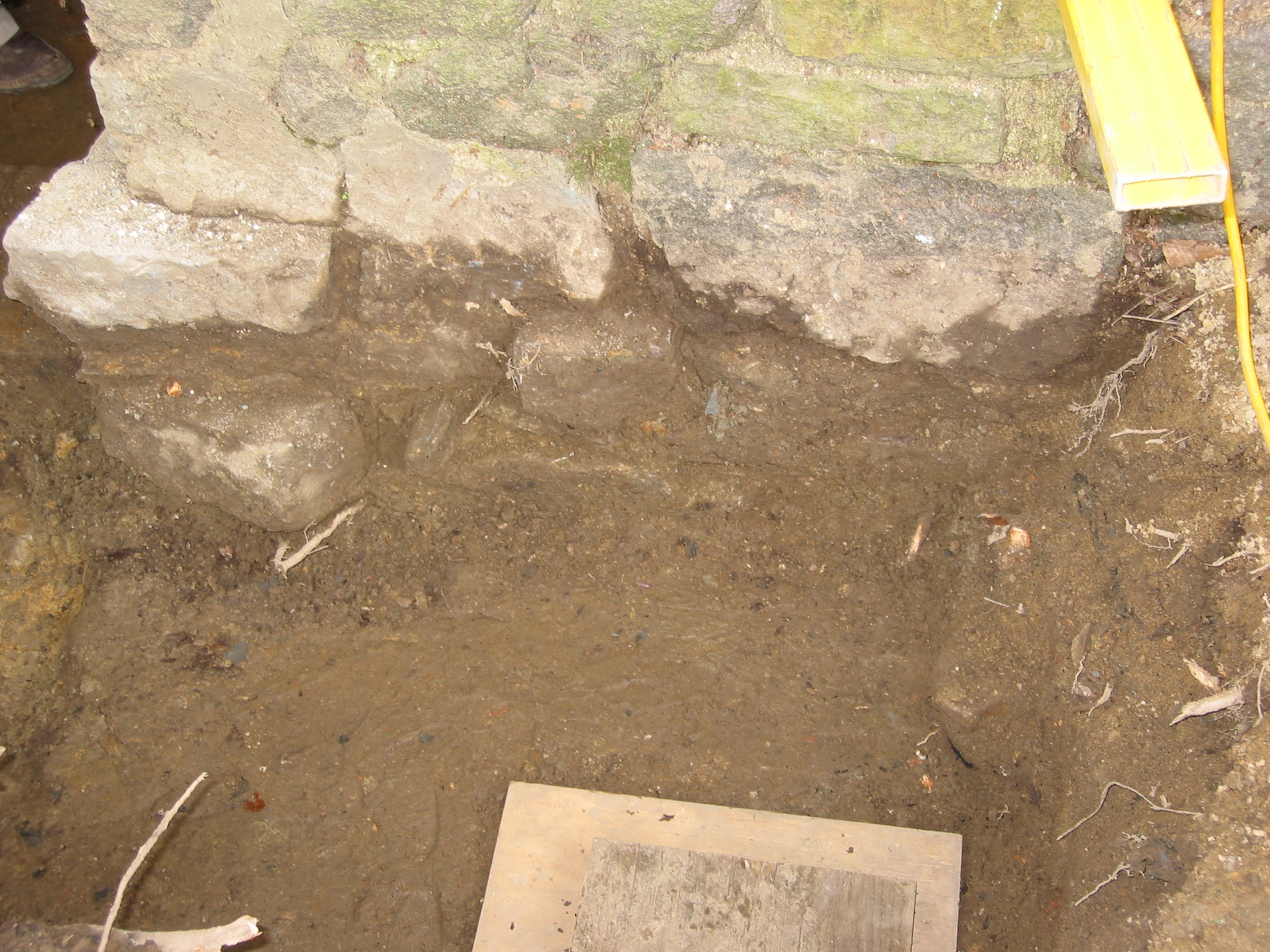
Excavated view of east foundation wall north of kitchen doorway.
Excavated 8 inches deeper than in DTR09PH67--1001.01.151, showing displaced stones [the soil-darkened stone to the left is rotated 45 degrees out of its corner position below later jamb plinth-block seen in upper left corner of photo]. Degraded mortar, caused by saturated soil's dissolution of lime content, loses its compressive bearing strength {1}, allowing movement in walls and, potentially, structural failure. Evidence of such deformations, displacements, and fractures in the north and east kitchen walls, fireplace and chimney structures, and in the vault abutment ["cross"] wall, appears in numerous photos in this collection and is discussed in the archive records describing those photos.
In order to effectively arrest masonry disintegration caused by degraded mortar, destabilized stonework was disassembled, relaid in plumb [“true”] vertical alignment, and consolidated with bonding mortar carefully applied to tightly fill in all potential voids and cracks. This traditional technique in constructing mechanically efficient random-rubble stone walls restored the virtually monolithic quality of the masonry and its ability to withstand concentrated stresses from the static forces from the building’s mass and from “live” [“dynamic”] loads imposed on the structure.
FOOTNOTES
{1} Masonry walls in plumb alignment have extraordinary bearing capacity in compression, within the order of magnitude of 5,000 pounds per square inch. The actual loads typically imposed on them compose a small fraction of their compressive strength ["crush-resistance"]. Although "bonding" does occur to some extent in a masonry wall, mortar provides minimal resistance to tensile and shearing forces, and presents only nominal friction-resistance to wall stones under lateral pressure, thus little impedance to stones incrementally or suddenly "sliding" across masonry joints. The primary function of bed-mortar is to evenly distribute and direct downward the compressive forces within the wall by tightly filling in voids and gaps between stones. This method, although termed "random rubble", forms a virtually monolithic wall-mass which effectively minimizes the oblique stresses which attack mortar joints and generate de-stabilizing thrust vectors outside the vertical core of the wall. Maintenance of the lines of force within its central segment assures that a plumb wall will remain in compression, capable of bearing loads well within the capacity of stone and mortar.
Laurence Ward, 2009
Catalog details
- Catalog number
- 1001.01.152
- Alternate number
- DTR09PH68
- Accession number
- 1001.01
- Date
- 07/28/2009
- Creator
- Larry Ward
- Object name
- Print, Photographic
- Record type
- Standard
- Classification
- Documentary Artifact