Description
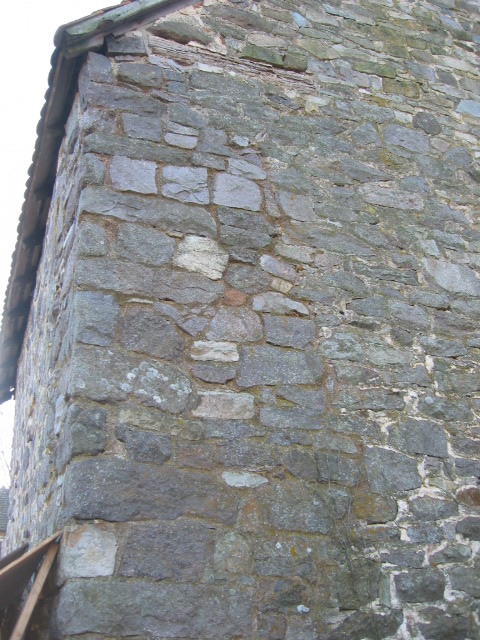
The jagged vertical crack descends from just under the joint between the east wall plate [upper left corner of photo] and the weathered horizontal oak plate tie extending 4 feet westward from the wall plate at the eaves level {1}. The darker pointing in the re-built north wall segment is left [east] of the crack in the photo, and the earlier [lighter colored] pointing to the right of the crack defines the un-restored portion of the wall{2}.
The alternating long stones at the corner of the north and east walls are sometimes called "quoins" [anglicized to "coin" in the 19th century], which compressively bind ["tie"] the vertical mortar joints close to the corner.
See an interior view of this repaired crack and the contrasting pointing in the wall ranges flanking the crack in DTR09PH95--1001.01.187
FOOTNOTES:
{1} See discussion to DTR09PH93--1001.01.185.
{2} See drawing DTHDWG1--1001.01.045 cited in footnote {3} of DTR09PH69--1001.01.153 showing the location of the crack in the "basement" plan view, with a note stating that the displaced wall "moved + or - 6 inches." According to drawing DTHDWG1--1001.01.045, this "tectonic" event in the random rubble gable wall forced the eastern corner segment of the north wall toward the west, partially over-riding the wall-range west of the crack. This through-fracture was repaired and the corner piers of the intersecting east and north masonry walls were relaid in the 1970s.
Laurence Ward, 2009
Catalog details
- Catalog number
- 1001.01.192
- Alternate number
- DTR09PH100
- Accession number
- 1001.01
- Date
- 12/17/2009
- Creator
- Larry Ward
- Object name
- Print, Photographic
- Record type
- Standard
- Classification
- Documentary Artifact